I am dedicated to open access research and believe that no articles should be behind a paywall. If you are unable to access any articles that I have contributed to, please reach out to me.
CWISE J105512.11+544328.3: A Nearby Y Dwarf Spectroscopically Confirmed with Keck/NIRES - Robbins G. et al. 2023 AAS ApJ
Y dwarfs, the coolest known spectral class of brown dwarfs, overlap in mass and temperature with giant exoplanets, providing unique laboratories for studying low-temperature atmospheres. However, only a fraction of Y dwarf candidates have been spectroscopically confirmed. We present Keck/NIRES near-infrared spectroscopy of the nearby (d ≈ 6-8 pc) brown dwarf CWISE J105512.11+544328.3. Although its near-infrared spectrum aligns best with the Y0 standard in the J band, no standard matches well across the full YJHK wavelength range. The CWISE J105512.11+544328.3 NH3-H = 0.427 ± 0.0012 and CH4-J = 0.0385 ± 0.0007 absorption indices and absolute Spitzer [4.5] magnitude of 15.18 ± 0.22 are also indicative of an early-Y dwarf rather than a late-T dwarf. CWISE J105512.11+544328.3 additionally exhibits the bluest Spitzer [3.6]-[4.5] color among all spectroscopically confirmed Y dwarfs. Despite this anomalously blue Spitzer color given its low luminosity, CWISE J105512.11+544328.3 does not show other clear kinematic or spectral indications of low metallicity. Atmospheric model comparisons yield a log(g) ≤ 4.5 and T eff ≈ 500 ± 150 K for this source. We classify CWISE J105512.11+544328.3 as a Y0 (pec) dwarf, adding to the remarkable diversity of the Y-type population. JWST spectroscopy would be crucial to understanding the origin of this Y dwarf's unusual preference for low-gravity models and blue 3-5 μm color.


Backyard Worlds: Cool Neighbors--Post-launch Performance and a First Proper Motion Discovery - Robbins G. et al. 2025 ASPCS
Backyard Worlds: Cool Neighbors launched via the Zooniverse online crowdsourcing platform in June 2023, pursuing ultracool dwarf discoveries through citizen science. Since the project’s launch, tens of thousands of ultracool dwarf candidates have been reviewed by Cool Neighbors volunteers to visually confirm (or refute) their status as high proper motion objects. We present a summary of the Cool Neighbors launch and highlight CWISE J133605.65+505330.9 as a first moving object discovery from the Cool Neighbors project. Based on photometry available for CWISE J133605.65+505330.9, we estimate it to be an early L or late M dwarf with polynomial relations yielding a photometric type of L1.2 ± 0.7 and a distance estimate of 127 ± 6 pc. The Backyard Worlds: Cool Neighbors project will continue to review ultracool dwarf candidates through crowd-sourcing during future years of operation.


We present the analysis of two unusually red L dwarfs, CWISE J075554.14-325956.3 (W0755-3259) and CWISE J165909.91-351108.5 (W1659-3511), confirmed by their newly obtained near-infrared spectra collected with the TripleSpec4 spectrograph on the Southern Astrophysical Research Telescope. We classify W0755-3259 as an L7 very low-gravity dwarf, exhibiting extreme redness with a characteristic peaked H-band and spectral indices typical of low-gravity late-type L dwarfs. We classify W1659-3511 as a red L7 field-gravity dwarf, with a more rounded H-band peak and spectral indices that support a normal gravity designation. W1659-3511 is noticeably fainter than W0755-3259, and the rounded H-band of W1659-3511 may be evidence of CH4 absorption.
Cool Neighbors: Combining Artificial Intelligence and Citizen Science to Chart the Sun’s Cosmic Neighborhood - Meisner, A., ..., Robbins, G., et al. 2024 Citizen Science: Theory and Practice
In this case study, we describe the design and implementation of the Backyard Worlds: Cool Neighbors citizen science project, which combines image-level deep learning with Zooniverse-hosted online crowdsourcing to mine large astronomical sky maps for rare celestial objects called “brown dwarfs.” Specifically, Cool Neighbors uses machine learning to pre-select the sky images shown to volunteers. Cool Neighbors represents an excellent opportunity to interrogate the effects of incorporating artificial intelligence into a citizen science project; its sibling project, Backyard Worlds: Planet 9, uses no artificial intelligence, providing a natural point of comparison for participant engagement metrics. Through analysis of more than 10 million total Zooniverse classifications from the combination of Cool Neighbors and Backyard Worlds: Planet 9, among other results, we find (1) Cool Neighbors volunteers perform ~3x more classifications per unit of time invested than Backyard Worlds: Planet 9 volunteers, and (2) each registered Cool Neighbors participant performs ~2–5x more classifications than each registered Backyard Worlds: Planet 9 participant. We also discuss our measured approach to presenting the complementarity of machine learning and citizen science in volunteer-facing Cool Neighbors materials. Finally, we present a survey of advanced Backyard Worlds participants, which indicates that these citizen scientists are by and large not dissuaded from participating in Cool Neighbors because of its usage of artificial intelligence.
In Prep / Submitted Manuscripts
-
Robbins, G., Hsu. H., Kempf, S. 2024, "Three-Body Dynamics of Impact Ejecta of Europa". To Be Submitted to the Planetary Science Journal.
-
Robbins, G., Foster, D., Nyavor, E. 2025, “Enhanced Rock Weathering of Basalt Soil Amendments – Mineralogy, Geochemistry, and CDR Potential”, To Be Submitted to the Geophysical Research Letters, AGU.
- AAS Division of Planetary Science 56th Meeting, Boise, Idaho. 10/6/2024-10/10/2024


- American Physical Society April Meeting, Sacramento, California. 4/3/2024-4/6/2024


- American Astronomical Society 243rd Meeting, New Orleans, Louisiana. 1/7/2024-1/11/2024

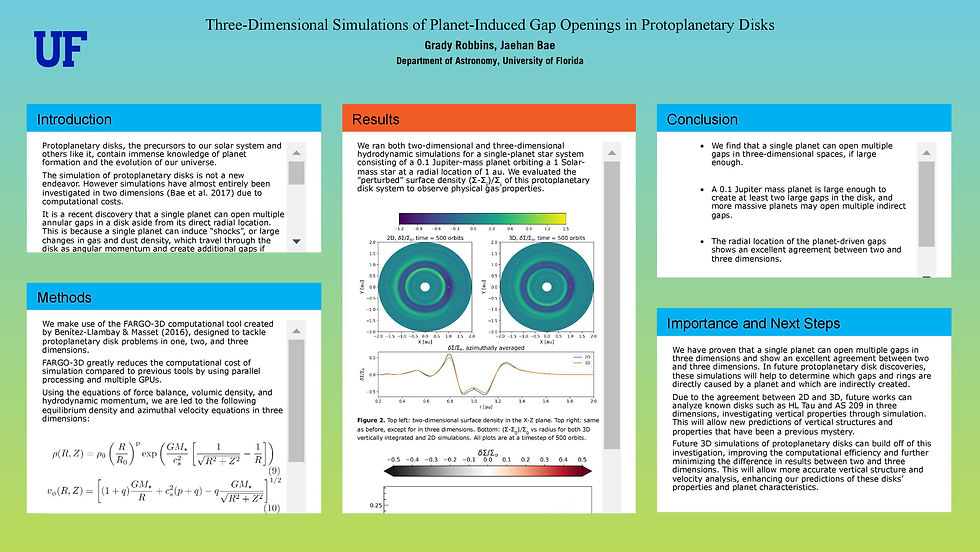
Click the link to view the iPoster!
- Gulf Coast Undergraduate Research Symposium, Houston, Texas 1/7/2024-1/11/2024


