
Research
My active research includes characterizing the mineralogy and geochemistry of rocks and soils in Jezero Crater via the Mars 2020 Perseverance Rover's SuperCam and Mastcam-Z instruments. I am beginning a secondary project mapping/modeling the stratigraphy of regolith at the Lunar Gruithuisen Domes in preparation for the Lunar-VISE mission. My senior theses at the University of Florida covered characterization and mineralogy of basaltic materials for use in agricultural soil amendments (BA, geology) as well as 3D hydrodynamical simulations of protoplanetary disks (BS, astrophysics). I am also involved in researching the three-body effect of impact ejecta of Europa and constraining mass escape with NASA and the University of Colorado Boulder. During my 2023 summer internship at NSF's NOIRLab, I analyzed the near-infrared spectra of brown dwarfs and helped develop the citizen science project Backyard Worlds: Cool Neighbors.
Europa Impact Ejecta - 2024 Internship @ NASA & LASP, the University of Colorado Boulder
During my summer 2024 Europa ICONS internship at the Laboratory of Atmospheric and Space Physics located in the University of Colorado Boulder, I worked with the Europa Clipper SUrface Dust Analyzer Deputy PI Sean Hsu and PI Sascha Kempf to model the trajectories of particles produced from impacts on Europa under the influence of Jupiter and Europa's gravity (the three-body effect). We have created a global map of the effective escape speed variation on Europa's surface and estimate the mass lost from micrometeorite impacts. We are working to understand the mass transfer from Europa to other Galilean moons from micrometeorite impacts, and compare these estimations to giant impact ejection mass escape. This research is currently active, and we are writing a manuscript to publish these findings.


A particle launched orthogonally from Europa's South Pole with an initial velocity of 2075 m/s re-impacts the surface (left), however a particle launched 5m/s faster from the surface performs a close gravitational flyby and escapes the system (right). This due to the addition of Jupiter's gravity, which is approximately ~1/5 Europa's gravity at the surface.
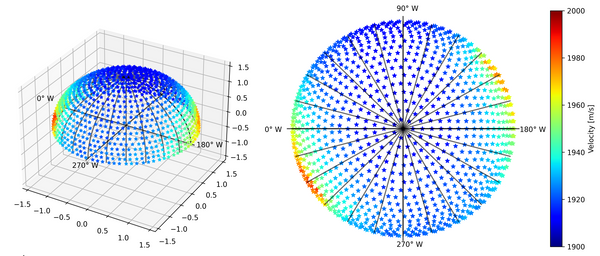
The 3D (left) and 2D projection (right) of the simulated global average effective escape speeds of particles launched 45° from local zenith across Europa's surface after incorporating the three-body effect. Each star represents the averaged escape speed cone of particles. 0◦ W points towards Jupiter and 90◦ W points towards the orbital motion
The 3D (left) and 2D projection (right) of the simulated global average mass escaping Europa due to micrometeorite bombardment based on a 45° average launch angle from an updated current mass-escape power law. 0◦ W points towards Jupiter and 90◦ W points towards the orbital motion.
Using this and plot and the above one, we estimate that roughly 9x10^14 kg of material has escaped Europa's surface using the average micrometeorite flux (see Krivov et al. 2003 and Hyodo & Genda 2021 for origin of micrometeorite flux reaching Europa and mass escape power laws
Protoplanetary Disk Simulation - University of Florida
Protoplanetary disks are the precursors to our solar system and all like it. They contain an immense amount of information on planet and star formation and properties. There are numerous features within a protoplanetary disk that hint towards planetary properties, such as intense gas/dust gaps formed from planetary motion. Previously, protoplanetary disks have been successfully simulated in two dimensions and applied to known protoplanetary disks such as AS 209, HL Tau, etc. In these simulations, it is a recent discovery that a singular planet, if massive enough, is able to open multiple gaps in a protoplanetary disk (Bae et al. 2017), and my research expands upon that discovery. By simulating a protoplanetary disk in three dimensions using parallel-processing GPUs via the University of Florida's HiPerGator supercomputer, I am proving that my simulations are accurate to two dimensions and that a single planet can open multiple gaps in three dimensions. This research will allow observational astronomers to compare our simulations to known disks and draw conclusions from the disks' potential vertical dimension properties and therefor more accurate constraints on planet-star characteristics. I have submitted a manuscript to the Astrophysical Journal of the AAS with these findings as the primary author with my advisor, professor Jaehan Bae.

The surface density accuracy comparison between 2D and 3D simulations of a 0.1 Jupiter-mass planet orbiting a Sun-like star at 1 au.
Top left: perturbed surface density in the X-Y plane for a 2D simulation. Top right: vertically integrated density for 3D simulation. Bottom: perturbed density vs radius for both 3D vertically integrated and 2D simulations. All plots are after 500 planetary orbits.
The 2D and 3D simulations show high accuracy to one another, varying slightly at the major density gap and walls (likely due to the extra degree of freedom for gas flow gained by adding a vertical dimension).
_edited.jpg)
The perturbed surface density of our 3D simulation, azimuthally averaged for a 0.1 Jupiter-mass planet orbiting a Sun-like star at 1 au. The plot is taken at 500 planetary orbits.
The primary and secondary gap formed by a single planet are emphasized in this plot, and they show that there is not major vertical gas variability that occurs within our simulation (hence the completely linear and vertical gaps).
Past Research
Near-infrared Spectroscopy of Brown Dwarfs - 2023 Internship @ NSF's NOIRLab
During my 2023 summer internship at the National Science Foundation's National Optical-Infrared Research Laboratory (NSF's NOIRLab), I successfully classified the spectral and gravity type of two brown dwarfs through Python-based comparisons and spectral measurements while under the supervision of Dr. Aaron Meisner. Brown dwarfs are substellar objects that never quite became stars, so they have masses below the coolest stars and may extend into the planetary mass regime. This achievement resulted in a publication titled “Scarlet Spectra: Two Red L Dwarfs Revealed by SOAR” published in the Research Notes of the AAS journal as the primary author and with Dr. Meisner and members of the Backyard Worlds team as co-authors.
After successfully publishing my first primary-author paper, I continued studying brown dwarfs with Dr. Meisner during my internship's final month. My research focused on the unique brown dwarf, CWISE J1055+5443 (W1055). My analysis of W1055's Keck/NIRES spectrum and photometric data confirmed it as a Y0 peculiar class brown dwarf. This discovery, supported by atmospheric model comparisons using a chi-squared best-fit metric, computational analysis of molecular absorptions, and photometric determination, has been transformed into a peer-reviewed research paper titled “CWISE J105512.11+544328.3: A Nearby Y Dwarf Spectroscopically Confirmed with Keck/NIRES,” which has been published in the Astrophysical Journal of the AAS as the primary author and 15 additional co-authors from the Backyard Worlds team including Dr. Meisner.

Keck/NIRES near-infrared spectrum for CWISE J105512.11+544328.3: original spectrum (gray) and 5-pixel smoothed spectrum (black). The spectrum is normalized to the J-band peak between 1.27 and 1.29 μm.

Top panel: The full resolution near-infrared spectrum of W0755−3259 (grey) and smoothed (black) compared to the
L5 near-infrared spectral standard and an L7 VL-G dwarf.
Bottom panel: The full resolution near-infrared spectrum of W1659−3511 (grey) and smoothed (black) compared to the L7 near-infrared spectral standard and an L7 INT-G dwarf . All spectra are normalized between 1.27 and 1.29 μm.

Cool Neighbors logo (credit: Matteo Gulla)

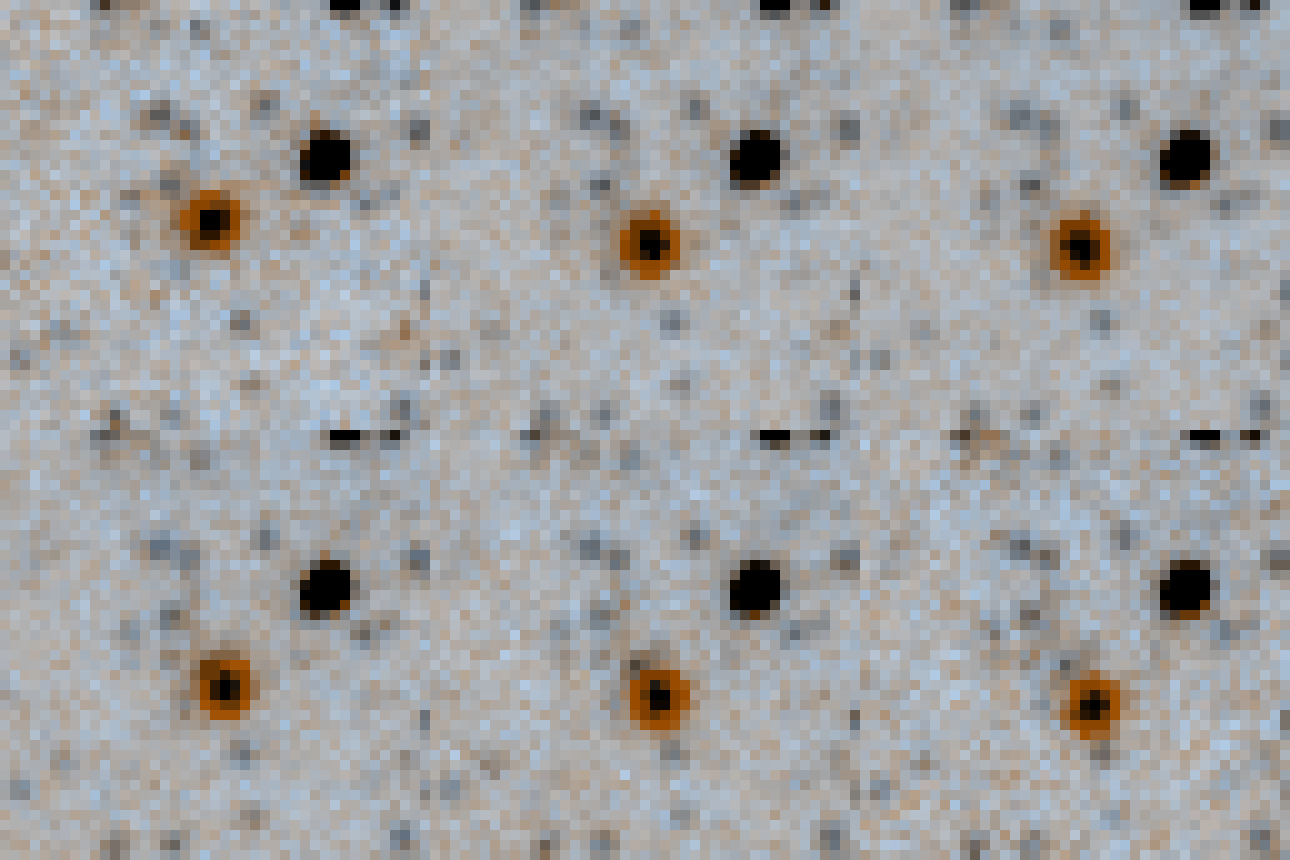
Example of a brown dwarf from the view of the Cool Neighbors project.
During my summer internship at NSF's NOIRLab, I was also a primary developer in the NASA-funded Backyard Worlds: Cool Neighbors project. The project is focused on using crowdsourcing via the Zooniverse platform to sift through large quantities of sky data in the search for brown dwarfs near our solar system, utilizing machine learning and artificial intelligence algorithms. I joined the Cool Neighbors project during its second and final year of development, where I evaluated the results from a recent beta test, created numerous public-facing materials for project promotion, and devised/implemented a Python codebase capable of processing large quantities of project classifications, resulting in the successful identification and extraction of targeted brown dwarf candidates.
Following the conclusion of my internship at NSF’s NOIRLab, I continue to be involved with the Cool Neighbors project and brown dwarf research. Roughly six months after the project launch, a wealth of information on accuracy statistics and new brown dwarf discoveries was available from completed classification sets. I worked with Dr. Meisner to write a manuscript titled "Backyard Worlds: Cool Neighbors – Post-launch Performance and a First Proper Motion Discovery" as the primary author, which is under review in the Astronomical Society of the Pacific Compendium of Undergraduate Research. The manuscript focuses on the Cool Neighbors launch, one of the project's initial brown dwarf discoveries, and the citizen scientists who discovered it.